
Customisation techniques for packaging ribbons
Customising a ribbon involves much more than simply reproducing a logo. The final result depends on the combination of material, weave, colour, design, printing technique and finish.
The same logo can produce very different results on satin, grosgrain or taffeta. Likewise, a single-colour design does not have the same requirements as an image featuring gradients, a graphic element intended to create dimension or a logo with a metallic effect.
That is why, at Manubens, we approach customisation as an integral part of the ribbon development process. Our expertise in a range of techniques at our production facility allows us to assess each project and determine which combination works best for both the design and the material, as well as for the final application.
It is not about choosing a technique from a catalogue. It is about developing the right ribbon for each project.
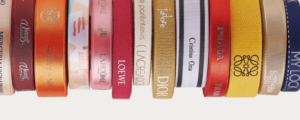
Three techniques, different customisation possibilities
Screen printing, dye sublimation and foil stamping offer different possibilities. Understanding their characteristics—and, above all, how they interact with different weaves and materials—is essential to achieving a coherent result.
1. Screen printing: visual and tactile versatility
Screen printing is one of the main techniques we use to customise ribbons. The ink is applied to the surface of the fabric, allowing the design to be developed not only through colour but also through its visual and tactile presence.
Screen printing can be used to create a variety of results:
Flat screen printing
Suitable for reproducing logos, text and graphic elements through a flat print applied to the surface of the ribbon. The final result will depend on the design, the ink and the characteristics of the fabric itself.
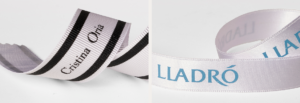
Raised screen printing
When we want to give the customisation a tactile dimension, we can add volume to specific elements of the design. The logo is no longer perceived solely as a visual element; it gains a physical presence on the surface of the ribbon.
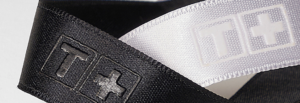
Metallic screen printing
By applying foil, we can add shine and reflective effects to logos or graphic elements. This is an especially interesting option when greater visual impact is required.
The versatility of screen printing therefore allows us to adapt the type of print to the effect required by each project.
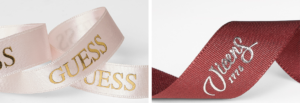
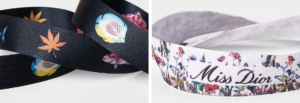
2. Dye sublimation: freedom for complex, multicoloured designs
Dye sublimation offers a different approach. It is particularly suited to polyester ribbons and makes it possible to work with multicoloured designs, gradients, images and more complex graphics.
Instead of producing the same surface effect as screen printing, the design becomes embedded in the fibres, preserving the ribbon’s original feel.
This considerably expands the creative possibilities and makes dye sublimation particularly suitable when a visual identity requires numerous colours, tonal transitions or a high level of graphic detail.
The choice between dye sublimation and screen printing does not therefore depend on which technique is “better”, but on the design we want to reproduce, the ribbon it will be applied to and the desired final result.
3. Foil stamping: when shine becomes part of the design
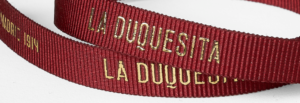
Foil stamping transfers a metallic film onto the surface of the ribbon, creating a high-shine effect with a distinctive visual presence.
It can be used to highlight logos, text or specific graphic elements in gold, silver and other metallic shades, adding contrast and differentiation to the overall design.
It is important to distinguish between screen printing with foil and foil stamping. Although both techniques can create metallic effects using foil film, their application processes are different. In screen printing, the design is first defined by applying a screen-printed adhesive solution to the ribbon, onto which the foil is subsequently fixed. With foil stamping, the foil is transferred directly using a die, pressure and heat.
Visually, the two techniques can achieve similar results, but the technology used and the method of transferring the metallic finish are different.
This distinction allows us to select the most appropriate solution according to the required level of shine, the design, the ribbon’s surface and the desired effect.
The ribbon and the customisation technique must be developed together
A printing technique will not produce the same result on every ribbon.
The smooth, glossy surface of satin behaves differently from the ribbed texture of grosgrain. Taffeta, herringbone and velvet also have their own characteristics, which must be considered when defining the customisation.
The same applies to the fibre composition. Polyester, cotton, nylon, linen, recycled polyester and organic cotton all have different characteristics that influence the possibilities of a project.
For this reason, before choosing a technique, we assess factors such as:
- The fibre composition and type of weave
- The ribbon’s background colour
- The dimensions and characteristics of the logo
- The number of colours and the complexity of the design
- The desired level of shine, dimension or texture
- The ribbon’s final application
- The project’s production requirements
This approach helps to avoid a common mistake: creating the design first and only afterwards considering how it can be produced.
When manufacturing possibilities are understood from the outset, we can work in the opposite direction, adapting the material, ribbon, design and technique to achieve the desired result.
Request a custom sample for your next project.
One design, different results
One of the best ways to understand the importance of the customisation technique is to imagine the same logo applied using different processes.
With flat screen printing, it may stand out primarily through colour contrast. Raised screen printing can add a tactile dimension. Metallic ink introduces reflective details, while foil stamping can achieve a different level of shine and metallic presence.
If the design includes gradients, images or a broad range of colours, dye sublimation opens up further possibilities.
The logo is the same. The perception of the ribbon is not.
In sectors such as cosmetics, perfumery, fashion, jewellery, gourmet food and gifting—where packaging forms part of the product experience—these differences become especially relevant.
Printing technique, weave and finish: a combined decision
Customisation does not end with printing.
The performance and final appearance of a ribbon depend on all the decisions made during its development. The weave, dyeing process, printing technique and finishes must be consistent with one another and with the intended application.
This relationship becomes particularly important when a project requires specific properties or finishes.
You can explore this topic further in our article about finishes for customised packaging ribbons.
Adapting the technique to the ribbon, not the ribbon to a technique
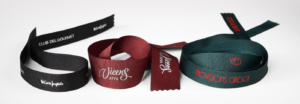
At Manubens, we have a range of customisation technologies at our production facility because not every project requires the same solution.
Our expertise goes beyond printing a ribbon. By controlling the manufacturing process—from warping and weaving to dyeing, printing and finishing—we understand how the different variables interact and can approach each project from a comprehensive perspective.
We can develop the weave, work on the colour and study how the design should be reproduced before selecting the most appropriate customisation technique. This ability to adapt is especially valuable in packaging projects that require colour consistency, precise logo definition, specific visual or tactile effects, or the accurate integration of the ribbon into the overall packaging design.
We do not begin with a single technique and adapt it to every project. We begin with each individual project to determine what the ribbon should be.
This is the value of combining manufacturing capabilities, different technologies and textile expertise within a single production facility.
Do you have a customised ribbon project?
We can assess the material, weave,colour, design and customisation technique to develop a solution tailored to your packaging requirements..