
The new European Packaging and Packaging Waste Regulation (PPWR) opens a new chapter for the packaging sector.
Since 12 August 2026, Regulation (EU) 2025/40 has been generally applicable across the European Union, although many of its requirements will be phased in over the coming years. Its objectives include reducing packaging waste, improving circularity and moving towards solutions designed to make recycling easier.
For brands, this means gradually reviewing how packaging is designed.
And when we talk about premium packaging, this reflection does not only affect the box, the case or the main container. Attention must also be paid to its different components, including ribbons and their finishes.
A new balance for premium packaging
A ribbon can serve very different functions: closing a case, wrapping a box, securing a product, forming a bow or acting as a brand presentation and differentiation element.
From the PPWR’s perspective, how a ribbon is considered will depend on its specific function and how it is integrated into the whole.
For this reason, it is not appropriate to analyse a ribbon in isolation.
The assessment must take into account the complete packaging and the relationship between its different components.
This raises a particularly relevant question for premium brands: a ribbon can provide aesthetic, tactile and brand value and, at the same time, must be properly integrated into the product’s packaging strategy.
PPWR: what changes and when
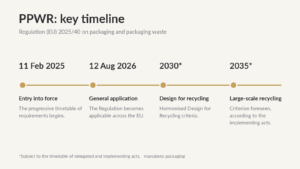
The PPWR entered into force on 11 February 2025 and began its general application on 12 August 2026. From here, a progressive timetable of requirements will unfold.
In terms of recyclability, the Regulation establishes that packaging placed on the market must be recyclable. The harmonised Design for Recycling criteria will apply from 2030, or 24 months after the entry into force of the corresponding delegated acts, if that date is later.
Subsequently, the PPWR will also introduce the large-scale recycling criterion, foreseen from 2035 or depending on the timetable set by the corresponding implementing acts.
This means that adapting should not be understood as a one-off change, but as a progressive process that will increasingly affect how packaging is designed and assessed.
It is not only a question of material
Faced with this new scenario, it may seem that the first decision is simply to replace one material with another.
But the reality is more complex.
The material of a ribbon is important, but on its own it does not determine the PPWR compliance of the packaging.
Design for recycling criteria take into account aspects such as the possibility of separating the different components and their behaviour in sorting and recycling processes.
That is why, in a packaging project with a ribbon, it is advisable to analyse three main aspects together:
1. Materials
It is necessary to know the composition of the ribbon and to study how it combines with the other materials that make up the packaging.
Polyester, recycled polyester, cotton, cellulosic fibres and other solutions have different characteristics and must be selected considering both the technical and aesthetic needs and the packaging project in which they will be integrated.
2. Customisation and finishes
A customised ribbon is not defined solely by its base material.
Dyes, coatings, adhesives, printing and other customisation elements are part of the final solution and may be relevant when analysing the behaviour of the whole.
In premium packaging, this point is especially important because finishes are precisely one of the elements that provide differentiation, perceived quality and brand identity.
The challenge is to integrate design, functionality and circularity criteria without losing the premium experience.
3. Separability
It is also necessary to analyse how the ribbon relates to the rest of the packaging and what happens to it once the product has been used.
Is it glued? Tied? Sewn? Can it be removed by hand? Does it remain attached to the packaging when it is discarded?
Separability is one of the parameters that the PPWR considers for developing design for recycling criteria.
Therefore, the way a ribbon is incorporated into the packaging can be as relevant as the material itself.
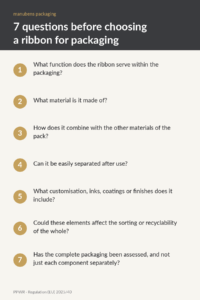
This is not a list to determine, on its own, whether a pack complies with the PPWR. It is a tool to identify aspects that should be reviewed during the development of the project.
Anticipating from the design stage
One of the main consequences of the new European framework is that many decisions will increasingly need to be made from the very start of the project.
Material, structure, components, finishes and joining systems are all part of the same solution.
At Manubens, we control in-house processes such as warping, weaving, dyeing, printing and finishing. This integration gives us technical knowledge of the different manufacturing stages and allows us to work on materials, customisation and finishes according to the needs of each project.
Our role is not to certify the PPWR compliance of a complete pack, but to provide specialised knowledge about the ribbon so that it can be correctly defined within the packaging project.
The earlier this variable is included in the brief, the greater the chances of finding the right balance between aesthetics, functionality, production and the new circularity criteria.
Premium packaging: getting ready without giving up brand value
The PPWR does not remove the importance of design.
For premium brands, the challenge will be precisely to keep creating differentiated packaging experiences in a context where circularity, traceability and the ability to justify the decisions made will become increasingly important.
A ribbon remains a visual and tactile element capable of transforming the perception of a pack.
The question is no longer only how we want that ribbon to be, but also how it fits into the whole, what it is made of, how it is customised and what happens to it at the end of its use.
Thinking about these questions from the start is a good way to begin preparing projects for the new European landscape.
Is your packaging ready?
We have prepared a guide with 7 points to review the ribbons and finishes of a packaging project.